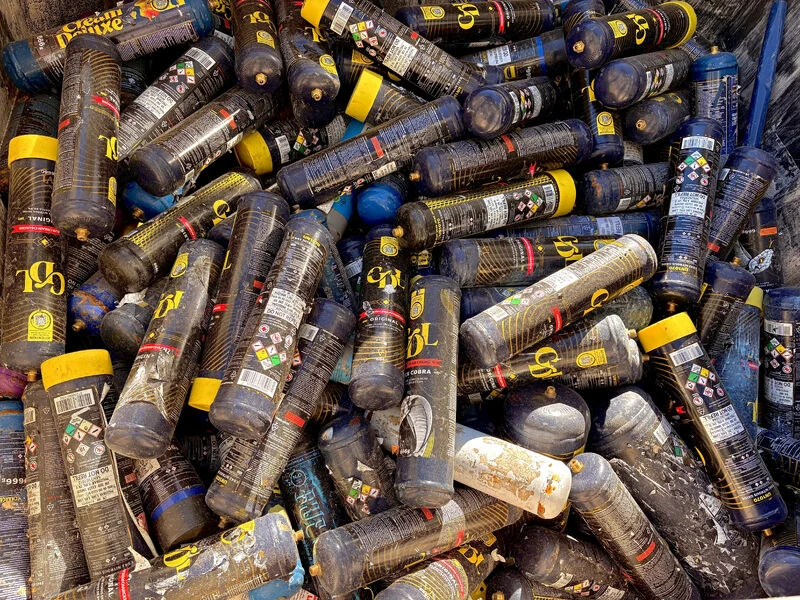
On a sorting line, hazardous items cost far more than their size suggests. A battery, a nitrous oxide canister or a gas cylinder can cause a line stoppage, a maintenance call-out, unprocessed tonnage, or even a fire that puts staff at risk. Detecting these items on the conveyor, before the high-risk stages, turns an unavoidable cost into a managed risk.
Which hazardous items end up on sorting lines?
These hazardous items have no place in selective collection, yet they reach the sorting center every day, mixed in with packaging and paper. The most common ones are:
- lithium-ion batteries, often built into e-cigarettes, toys or small devices thrown away whole;
- nitrous oxide (N2O) canisters, diverted from their culinary use and discarded in large numbers;
- camping or DIY gas cylinders, sometimes still charged.
The volumes are far from negligible. In sorting centers equipped with Wasoria gantries, between 10 and 60 N2O canisters are removed every day, depending on the sorting center. At Tricéa, in Torcy (France), around 5 batteries a day are spotted on the line.
What does a hazardous item cost a sorting center?
The cost of a hazardous item is not limited to the item itself. It is measured in lost time, unprocessed tonnage, replacement parts, and risks to staff and equipment.
Line stoppages and unprocessed tonnage
When a gas cylinder or canister jams a screen, a separator or a press, the line has to be stopped to remove it safely. Meanwhile, incoming loads keep arriving at the tipping floor: the delay carries over to the next shifts, sometimes into overtime.
For a sorting center whose economics depend on steady throughput, every unplanned stoppage is a direct production loss.
Maintenance and equipment damage
Made of steel, N2O canisters are incompressible objects: they score belts, damage screens and put heavy strain on the baling press. On top of this damage come maintenance call-outs, often urgent, and premature wear of parts.
Fires: the heaviest risk
A crushed or punctured lithium battery can ignite within seconds. A gas cylinder with residual content can burst under compression. In France, fire damage in sorting centers is estimated at around €100M a year. A major fire can shut a facility down for months and force tonnage to be diverted to other sites. This is what fire prevention in sorting centers is about.
Staff safety
Behind every hazardous item are sorting staff who are exposed: bursts, fumes, fires breaking out near sorting cabins. For a waste authority, staff safety is a legal duty, but also a matter of job attractiveness and team trust.
Why these losses long seemed inevitable
For a long time, sorting centers had no reliable way to spot hazardous items before they caused damage. The stream never stops, items are often hidden under other waste or built into devices, and sorting operators already have plenty to handle. Stoppages and repairs were therefore absorbed as operating costs, hard to anticipate and rarely broken down in detail.
Computer vision and machine learning change the equation: what could not be seen yesterday can now be detected, counted and tracked.
How automated detection of hazardous items cuts these costs
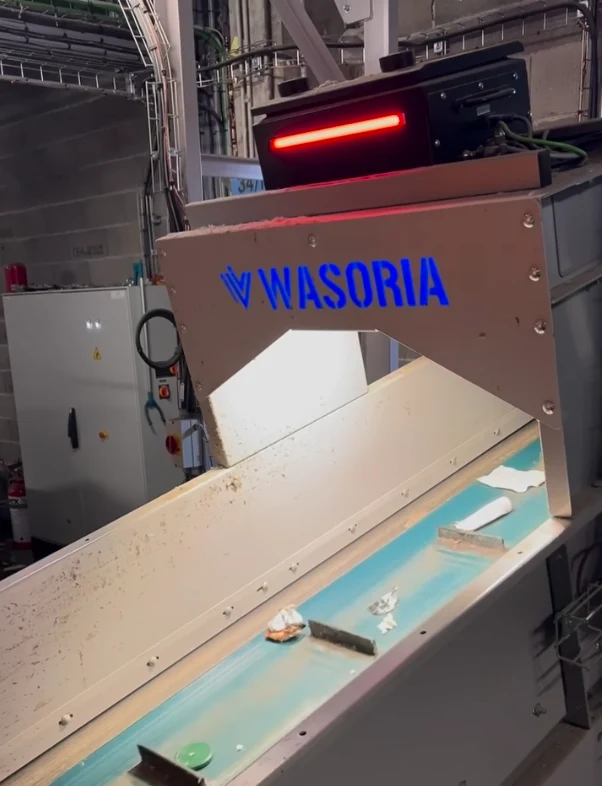
The Wasoria Box is mounted on a gantry above the conveyor. It combines an RGB camera, a thermal sensor and embedded artificial intelligence that analyzes every object in real time. When a hazardous item is spotted, an alert allows it to be removed from the stream before the compression stages, where it would do the most damage.
detection rate for gas cylinders and nitrous oxide canisters
Elcimaï certification
Detections are reported in Wasoria Pilot. Operators track them over time, identify the most exposed periods and streams, and get objective data to discuss sorting guidelines with local authorities. Around forty gantries are now in operation across France.
What savings can your sorting center expect?
Savings depend on each facility: type of streams, throughput, line layout, frequency of stoppages and incident history. Wasoria estimates that a single gantry can save up to €150,000 a year, depending on the facility.
potential savings per year with a single gantry, depending on the facility
Wasoria estimate
For large facilities handling higher tonnages, savings are estimated at up to €500,000 a year. These figures remain estimates: the actual figure is built from your site's data, such as the number of stoppages, maintenance costs and past incidents.
Frequently asked questions
Isn't manual sorting enough?
Operators cannot systematically spot hazardous items hidden under other waste or built into devices, on a stream that never stops. Automated detection supports them without replacing their expertise.
Does detection replace prevention at the source?
No, it complements it. Batteries, canisters and gas cylinders belong at recycling centers or drop-off points, never in the recycling bin. In France, local authorities can draw on resources from ADEME, the French ecological transition agency, and from producer responsibility organizations such as Citeo, the French packaging EPR scheme, to share these guidelines with residents.
How can I estimate the savings for my sorting center?
From your operating data: recorded stoppages, maintenance call-outs, past incidents and fires. The Wasoria team builds this estimate with you, following an approach tailored to your site.